Showing posts with label science. Show all posts

10.09.2007

reduce carbon!

so i just had an extremely nerdy revelation: all this talk of "reducing carbon" is, well, accurate.

we want to reduce carbon. as in, the opposite of oxidizing it.

now, i don't know how many of you remember high school chemistry and the concept of REDOX, but i'll try to make it simple. When we're talking about carbon (which cycles throughout the atmosphere, from plants photosynthesizing CO2 into sugars and other organisms breaking it back down), oxidation is the process that animals do (breaking it apart from other atoms and attaching it to oxygen), and reduction is the process that plants do. Anything that takes energy from carbon-based materials, be them hydrocarbons such as those found in gasoline, or simple sugars or even proteins that animals eat, is oxidizing the carbon. It's outputting CO2. Processes which remove CO2 from the atmosphere (which, last time I checked, all the environmentalists were advocating) are reducing carbon.

So Al Gore is right when he says that we need to reduce carbon. We need to reduce more carbon than we're reducing right now, that's for sure.

9.07.2007

it's friday

it was brought to my attention last night that I haven't been blogging with much regularity recently. As I explained (and as my archives will attest), i tend to go through phases as far as blogging is concerned, and i've learned the hard way about divulging too much in this seemingly protected forum. When I'm blogging less, it generally means that I'm living more, and the past few weeks have been no exception.

August was a busy month, and the first few days of September have offered little reprieve from the insanity. Between putting together a show of my photography (all month at the copper vine, 1315 E Pine, check it out if you're in seattle! better yet, come to my opening, 6-9pm, next Tues. the 11th), taking pictures with my bike for the bike girls' calendar, taking the damn GRE, and work, I've been booked. Solid.

It's not goign to get better over the next few months, but it will be slightly less insane for a few weeks. I leave in less than a week for more than 2 weeks on islands far from any continent, during which time I hope to work on my tan and write my grad school application statements.

today, however, is no reprieve: I've got 17 batches of fish in the incubator, at various stages of treatment. If all goes well I should get a good dose-response curve from one of the mutants we've been working with, and possibly find a few heterozygous pairs of another. then I have to take down other fish for a screening run I'm doing next week, take pictures of fish slices so that the EM guy knows what he's looking at, scan negatives from this week's EM runs... oh, and see if the agarose I need came in, and if it did, run out on a gel the products from yesterday's PCR.

8.24.2007

it was inevitable

so this morning, for the first time ever, i made the classic molecular biology mistake: mixing up the leads on the gel box.

doh!

8.22.2007

i heart auditory neuroscience

i've been on a bit of a brian eno kick the last week or so. i just impulse-bought another of his albums: nerve net, from 1992. it's really interesting music. as you should expect from mr. eno. he's better than anyone at creating aural landscapes: check out his "music for airports". it is absolutely just that - listening to it you feel as if you're waiting for a flight or changing planes. "nerve net" is a bit less ambient and a bit more upbeat, but it's still very richly-textured, slowly-evolving ear candy. i'm a fan. more than that, i think that he's probably got a decent grasp on how auditory cortex works and how music really is formulas, and you can use these formulas to create a predictable outcome in the listener's experience.

i've been reading jeff hawkins' on intelligence, and i'm not quite far enough in to do much in-depth analysis, except to say that i think he's missing a huge point, but i will withhold final judgement until i'm finished with the book. but it's got me thinking about computational models of cortex, and ways to simulate how our brain works, or at least to understand it. hawkins holds to the theory that there's a common cortical algorithm; that is to say, all parts of cortex, whether auditory, visual, etc. use the same fundamental method to find patterns in the environment. it's an interesting idea, and i definitely think there's probably some truth to it. but to say that in an adult human, visual cortex is the same as auditory cortex is the same as prefrontal cortex isn't exactly going to be accurate. though it's been shown that developmentally, they are interchangeable. anyway... too soon to know for sure, i'll have to finish the book and then wait 20 years before i can really know whether or not he's right.

(side note: watch hawkins give a talk on how brain science is going to change computing. he's a big-picture thinker, that's for sure.)

the question that remains, of course, is what that cortical algorithm is, how it works. and, of course, whether it's still too early to understand the cortex fully, because we don't completely understand all the underlying structures, and since the cortex is like built on top of and inextricably intertwined with the "lower" brain structures, without a bottom-up understanding our top-down knowledge will be incomplete.

post-gre post

(aww, hell. this is post #1134 to this blog. reminds me of the days of spelling out bad words on old one-line calculators.)

so... i basically took the GRE yesterday and told it where to stick it. i am the boss of that test. i pwned it, even. it's over now, which is awesome.

so it's time to shift my thinking away from the highly specific reality of the GRE and towards the much more nebulous world of science. in which i do PCR and occasionally write some stuff. yay, science. more later, on science, most likely.

8.08.2007

the fun(ding) game

So i'm in the beginning phases of writing my first major grant - an NSF graduate student research fellowship. It's basically about $120,000 over 3 years, most of which is stipend but also includes $10K for research costs and a fund for international travel for the purposes of research. So far, it's just a few ideas floating around in my head, and a bunch of brainstorm notes in a notebook. Hopefully before Nov. 7 it will be a fully-formed, scientifically sound, and relevant question.

Obvs I'm not going to talk about the scientific details of my proposal, at least until it's turned in, but suffice it to say it is generally about vertebrate nervous system development. And that it should be good. We'll see though.

Between now and the new year, I have 2 GRE exams, 5 to 8 grad school applications, and 1 NSF grant proposal to finish. And that's just stuff for work/school.

Before the 1st of September, I have 1 GRE exam, 5 photos to take (with me as model, not photographer), a show of my own photography to curate (all September at the Copper Vine), and a wedding to attend. And that's not counting all the data I need to collect on the fishies.

Fun stuff...

8.03.2007

fry day

another week down, wtf? my second week of full-time work, y'know, like with a paycheck and everything. i'm pretty excited about that; cash flow is always a good thing. things are still a little slow as i'm trying to get into the swing of things. there's not a lot to do when you don't have fish; i have to come in on saturday to set some up. there's a 6-day turnaround between setting up breeding pairs and having larvae to screen, so it'll be next friday before the fish from tomorrow's cross are ready to be experimented with. but once i get into the pattern, figure out what days i'm doing what with which fish, my productivity should skyrocket. crank out that data left and right.

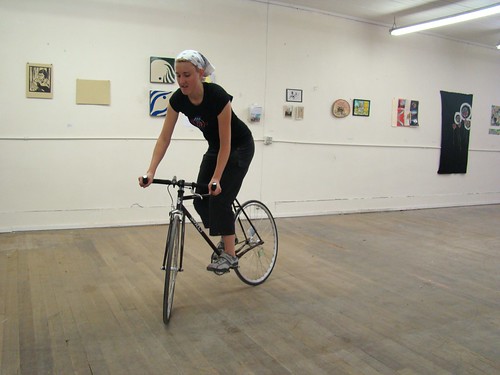
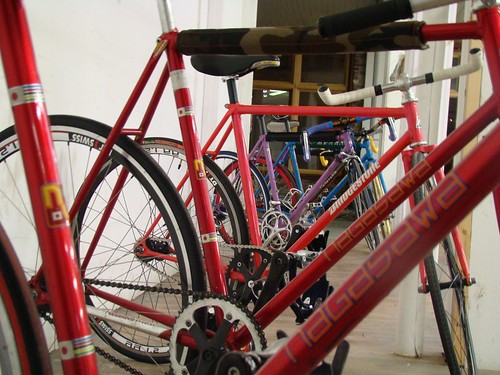
what else? lots of riding bikes. yesterday was a very decent ride, put in significant mileage and had a good time while doing it. went and visited mobius cycles downtown, and had fun riding around their lounge/art gallery space:
DSC01655.JPG
DSC01678.JPG
that's me on a fixie, trying to trackstand. the picture makes me look a lot better at it than i really am; i think i held that for about a second before falling out of it. oh well; once my old sekai is converted i'll be able to practice a lot more. :D

7.09.2007

When I grow up...

So PZ has posted in reply to a question posed by David Ng - Do Biologists have Physics Envy? I'm going to have to disagree with PZ's reply with a resounding YES, I do wish I had a better grasp on physics. That said, I also think that all (ok, not all, but most) physicists should stop chasing elusive particles and seductive mathematical models and start working on problems posed by biology.

So, here are my replies to the 3 questions:

1. What's your current scientific specialty?
I just finished my undergraduate degree in Cellular, Molecular, and Developmental Biology, so if that's a specialty, then it's mine. However, that's a bit vague, so I'll narrow it down by saying that I'm most interested in developmental neurobiology, and that I'm also well-versed in the niche field of hair cell death by ototoxic drug exposure. I could go on here (for days, probably) about everything I find interesting, but really, I'll spare you. You get enough of that if you read my blog. :)

2. Were you originally pursuing a different academic course? If so, what was it? Yes. I started my undergraduate career at Stanford studying mechanical engineering. I burned out, dropped out, went through an "I'm going to be an art major!" phase, and then rediscovered my love of science prior to enrolling and finishing my BS at UW.

3. Do you happen to wish you were involved in another scientific field? If so, which one? Well, not exactly, but I do want to expand my knowledge base into other fields. I am probably going to apply mostly to neuroscience programs, instead of traditional cell biology or genetics programs, because I want to gain exposure to some more of the computational and physics side of things. I think it's important to start formulating our biological questions in ways that people more trained in computational sciences can understand and contribute to, and in order to do that, I need more exposure to math, especially network theory and statistical modeling, and to physics, including quantum physics and physical chemistry.

7.05.2007

How do you map a gene?

One of the questions that's most frequently asked about my research, and one that I'm never able to answer concisely and satisfactorily, is this one: How do you map a gene? And although the answer is a bit long and involved, it's not too difficult conceptually, once you get a few basics out of the way.

The first thing you need in order to map a gene is some sort of variation in that gene, be it mutants vs. wild-type, or a polymorphism in the population (say, red hair vs. brown hair). You need to be able to sort out, based on phenotype, which individuals have the wild-type version and which ones have the mutation or polymorphism. Usually, this means you need an assay, whether it's based on morphology, drug treatment, behavior... however you do it, you need to sort your animals into two categories. One other important thing to keep in mind is that the mutants and the wild-types, in most cases, come from the same families: they are siblings, so they're genetically nearly identical except for the gene you're looking for, which is causing the phenotype you're sorting by.

The next thing you need is a library of markers of known genomic location. For zebrafish and many other animals, this has been published - and new markers are added constantly. zfin.org is one place to find these published markers. Here is a link to a map of these markers. Click on a chromosome button (referred to as LG, or linkage group, on that site) to see the map of the chromosome and all the markers. Click on an individual marker to see all the published information about it - location, sequence, who discovered it, etc.

Most of the markers in this particular map, which is one that I use extensively in my work, are known as Z markers, and are identified with a Z and then a number, such as z1234. These "markers" are also known as SSLPs, or simple sequence-length polymorphisms. This means that they are sites which vary in length between different strains and even individuals within a strain. This makes them very handy for our purposes.

SSLPs are usually found around sequences of di- or tri-nucleotide repeats, such as a stretch of AGAGAGAGAGAG base pairs. The reason they have length polymorphisms is that when the DNA replication machinery is copying these short repeated sequences, the enzyme is likely to "slip" and copy a few bases twice. These events happen fairly often (evolutionarily speaking), and randomly, and the end result is that there are many different length alleles in the population. Length differences are easily detected by PCR and gel electrophoresis. This gives us an easy way to determine a fish's genotype at a particular site. By comparing individuals to their parents, we can determine which chromosome is from Mom and which one is from Dad.

There's one more important point to make before I get into the nitty-gritty of actually mapping the gene. Mutations are made on a lab "wild-type" strain - in our case, we use the *AB line for mutagenesis. ABs are useful because they are fairly genetically uniform, and have very few lethal mutations hiding out in their genome. But they are bad for mapping, because the SSLPs tend to be the same length in all the fish. Once a family has been identified with a mutation, one of the carrier parents is outcrossed to another strain - WIK, in our lab - which has different SSLP sizes at most of the sites, and is actually known as a "polymorphic mapping strain" in many labs.* So once the outcross is done and another carrier pair identified - these fish are *AB/WIK genotype - the offspring of this cross are sorted by phenotype and then their DNA is extracted. We also get the DNA from Mom and Dad, as well as the founder grandparent fish, and the wild-type WIK animals used for outcrossing.

The first step in mapping the gene is to determine gross linkage, or to answer the question: What chromosome is the mutation on? In order to figure this out, we make pools of DNA samples from the mutant and the wild-type sibling fish. We then test SSLP markers on pooled mutant DNA, pooled sibling DNA, and Mom, Dad, and grandparent DNA samples. Here, we're looking for a particular pattern: Mom, Dad, and the wild-type siblings should each have two bands, or two length alleles for the marker (since they have both an AB and a WIK chromosome); the grandparent and mutant samples should each only have one, and it should be the same one (since the mutation was made on the AB background).

Here are some simulated ASCII gels. The lanes, from left to right are: mutant pool, sibling pool, Mom, Dad, Founder Grandparent. (Note: on all these gels, the single line should line up with the bottom of the double lines. It doesn't really work right in this font, but pretend.)
The first gel is a non-informative marker:
----- All the samples have a single band of the same size. We can't learn anything from this.
The second gel is an informative, but unlinked, marker:
====- Mutants, siblings, Mom and Dad all have alleles from both the AB and the WIK chromosomes. These are recessive mutations, and the mutation is carried on the AB chromosome, so it can't be here, since the mutants have AB/WIK genotypes.
The third gel is an informative, linked marker:
-===- Mutants have just the AB band, meaning they are homozygous at this location. This is good evidence that the marker is near the mutation.

So you test markers on each chromosome (zebrafish have 25) and look for the linkage pattern. Once you find a chromosome that shows linkage to the mutation, it's time to switch tactics and go for fine mapping.

For fine mapping, or determining where on the chromosome the mutation is, we abandon our pooled DNA and work with individual DNA samples. We need as many of these as we can get, so we keep breeding our mapping pair (Mom and Dad) and sorting out the offspring based on mutant phenotype. (Remember that recessive traits are found in 1/4 of a carrier pair's offspring... do a Punnett square if you can't remember how that works.) So 1/4 of the offspring are identified as mutants, and the other 3/4 are siblings. Of these siblings, 2/3 (or 1/2 of the total) are heterozygous, or carriers, and 1/3 (1/4 of the total) are homozygous wild-type, or don't carry the mutation. Most importantly, though, every individual identified as a mutant must be homozygous at the site of the mutation.

So what we do here is we test markers all up and down the chromosome we've identified on all of our DNA samples - mutant, sibling, and parents and grandparents. Due to recombination, not all the mutants will be homozygous at all of the locations we test - and the proportion of those who are homozygous (show up with just one band - instead of two =) is directly proportional to how close the marker is to the mutation. Recall that during meiosis, when germ cells (sperm and egg) are being formed, crossing over occurs between homologous chromosomes (i.e. your copy of 5 from mom and your copy of 5 from dad), creating new chromosomes with bits of each. BUT - we know that all the mutants must have the AB chromosome only at the location where the mutation is, so we use this information to narrow down where the mutation is.

Here's another sample gel. This time, individuals are listed vertically, and each column is that fish's genotype at each of 5 different markers.

mutant A - - - = =
mutant B = - - - -
mutant C = = - - -
mutant D - - - - =
mutant E = = - - -
wt sib A = = = = =
wt sib B - = = = =
wt sib C - - = = =
wt sib D = = = - -
wt sib E = = = = -

Based on these results, we can conclude that the mutation is closest to the third marker - since all the mutants are homozygous and all the sibs are heterozygous here. (In reality, some siblings would also have just one line corresponding to the upper band, but I can't really do that with the ASCII at my disposal.) By testing hundreds, if not a thousand, mutant and wild-type fish, you can find a pair of markers between which the mutation must lie. By testing markers that are closer and closer together, you can narrow down the region to a few hundred thousand base-pairs, after which the mutation is mapped, and now needs to be cloned. But that's another post for another day.

This all sounds pretty easy and straightforward, and while it's conceptually simple, it's a lot harder in practice. One challenge that has hampered my progress is finding polymorphic markers - markers with different lengths between AB and WIK fish. There are also challenges with breeding and identifying mutant fish - sometimes the fish don't "give" (spawn) well, and after about a year an old pair will just stop giving. It can take a long time to map and clone a gene, as I've proven by taking more than a year and a half to find this one... or you can also get lucky and find it relatively quickly. Like anything in science, it's probably 50% luck, 50% hard work.

So that's my post on how to map a gene. The details vary by organism, but it's pretty much the same in principle - whether you're mapping the cystic fibrosis gene in humans or a novel mutation in zebrafish, fruit flies, or yeast. This whole process is known as "positional cloning" - finding the gene by its position in the genome. It's labor-intensive and slow at times, but it's a powerful method for finding a mutation that could be anywhere.

(* I have my own theories as to why this line is so polymorphic, but they're all unfounded at this point, just based on observation and hearsay. There's a chance that I'll end up exploring this as a part of my Ph.D. work... but until then, I'm going to leave those theories out.)

7.04.2007

nerd convention

DSC00758.JPG
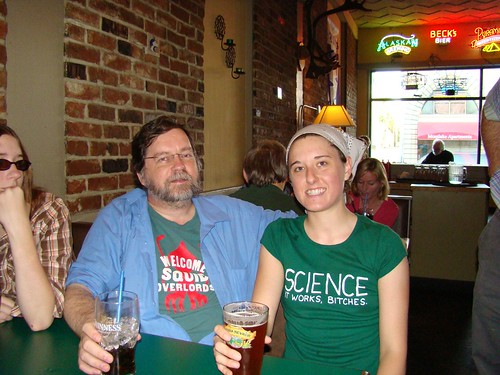
yeah, so i met pz myers last night at drinking liberally... he's every bit as scary as the rumors suggest. fortunately i managed to escape unscathed. we even got to talk science for a bit, after the throng of worshippers died down. there were also several candidates there, stumping for the primaries, so I had a chance to talk to bill sherman, who is running for county prosecutor... who says he will do "everything that's good, and nothing that's bad" if elected. well gee, you've got my vote...

6.21.2007

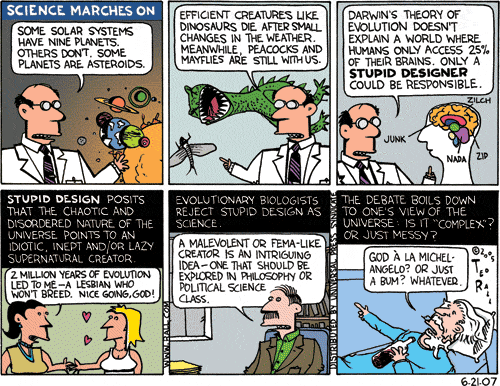
stupid design

:D

(via pharyngula)

5.05.2007

4.26.2007

i'm a noid today

maybe it's the lack of sunshine, or maybe it's just random fluctuations, but i have to say that today was a high for me on the annoy-o-meter. it may have started in my biochem section, which is a complete waste of 50 minutes because my ta doesn't know what the hell he's talking about and doesn't really care, and because there's one Annoying Question Girl in my section (you know the type). it doesn't help that she speaks in this super-breathy, high-pitched voice that is Just. So. Subservient. it makes my skin crawl. AND! she raises her hand! who does that??? in a section of less than 10 people, don't you think you could just... say it? waaaaaagh.

it may have been the biochem section, or it could also have started earlier, when i was loading a gel and it just ripped in half. straight down the bottom row of wells. fortunately i noticed before i filled it with my DNA samples; but i wasn't able to load the bottom row of the gel, so i only got half the data i should have, and have to run another gel tomorrow to get the other half.

it also could have been earlier when i was setting up the PCR that i later loaded into a gel. i was going through the freezer finding all the DNA samples i needed, when a rack of tubes that had been just stuck onto a shelf came crashing down, spilling tubes everywhere. tubes go in boxes before they go in the freezer, or at least they should in order to prevent accidents like that one. the culprit was politely informed of the situation, but - of course, because this is seattle and we all do this - i was super-nice about it, though 30 minutes later i had been cursing and fuming. picking up 80 1.5-ml tubes that have scattered across the floor? not fun.

on the other hand, i did get data today, and the marker i got data from is very close to my mutation.... closer than any other i've tried so far. which is good. i need to run more samples to determine if it's on the other side of the mutation from my current closest marker, which would be good, or if it's on the same side but that much closer, which is actually also not bad. data is always good, especially when it doesn't make you go "WTF??"

what it boils down to is that i'm exhausted, mentally and emotionally. i have the urge go bury myself under the covers and let it all go away. but i have errands that aren't going to run themselves... sigh.

4.25.2007

in which i digress from my own knowledge

... and speculate on fields in which i am no expert, nor a student, but merely an outside observer.

for some reason, it's not particularly common among scientists to believe in astrology, or to check one's horoscope each morning before leaving the house. but while it's doubtful that "personalized" daily predictions could ever be accurate - beyond what happens by coincidence and vague wording - there's one gaping hole in our understanding of the fundamentals of physics, and it might have something to do with astrology.

(caveat: speculative, moderately crazy-talk thinking follows.)

ok, i'm no physicist, but i do have a pretty good working understanding of mechanics and electromagnetism. i'm a bit shakier on the whole quantum thing, but i at least have a decent grasp on the basics, and can accept the fact that fundamentally, everything is stochastic and based entirely upon chance. (which is not to say that it is random.)

what's missing from our Theory of Everything is how gravity comes into play with the whole quantum theory thing... how it interacts with atoms and molecules, what forces gravity might exert on a chemical reaction. there have been numerous (purely theoretical) attempts to explain gravity's place in quantum theory: string theory and loop quantum gravity come to mind. frankly, i don't understand either one nearly enough to explain it. but it is true that gravity must *somehow* act at the molecular level, or else we wouldn't all be here. and there are other things at the large molecular level (protein folding is a big one) that have yet to be explained by anything but the most complex of computations (for the simplest proteins). and it's not just that. how does a protein find its binding partner, when the concentration of the ligand is infinitessimally small (in the case of biotin and streptavidin, the most extreme example, on the order of 10^-15 mols/liter, or the femtomolar scale*)? what determines whether one single (but critical) sodium channel opens or stays shut, triggering or preventing an action potential that could lead to many downstream consequences?

could gravity somehow be the answer? could the mass of the earth exert an influence on chemical interactions within cells? could the moon? the sun?

how the hell would you go about testing something like that?

* digression: i'm not sure you really get how tiny femtomolar concentrations are. Avogadro's number is 6.02x10^23... i'm going to round and call it 10^24. So there are 10^24 molecules in a mole, or 10^24 molecules per liter of solution at 1 molar (M). If the concentration is 10^-15 M, then that means there are 10^9 molecules, or about 10 billion, in a liter of solution. Now consider the fact that the volume of an average cell is around ***quick calculation*** 1.25x10^-16 (mm^3). a cubic millimiter is the same as a microliter of water - 10^-6 liters. so that makes our cell volume 1.25x10^-10 liters. 10^9 molecules per liter times 1.25x10^-10 liters = .125 molecules per cell volume. and yet this is how low the concentration of streptavidin must be before half of the bound biotin releases its SA! tell me there isn't something freaky going on there.

synapse assembly and plasticity!

so i went to a lecture this morning given by Ann Marie Craig, who is currently at UBC, talking about the work she's been doing there and previously at WashU on synapse assembly and plasticity. most of her work was focused on neurexins and neuroligins, which i incidentally did a project on last summer quarter for bio 401. i'm not going to go into detail about these molecules right here and now, but the short of it is that neurexins are expressed on presynaptic neurons and neuroligins on postsynaptic neurons, and the interaction between NXs and NLs is a key interaction in synapse assembly. what makes these guys so difficult to study is the fact that each one has several splice isoforms - especially the neurexins. the long (alpha) isoform of neurexins has 5 splice sites, and the short (beta) isoform has 2 (confusingly called S4 and S5, since they are homologous to the 4th and 5th splice site in alpha-neurexins). so the Craig lab (as i understand from her talk this morning) has shown among other things that the "insert" in splice site 4 (S4) of neurexin 1-beta makes it bind specifically to neuroligin-2, which is specific to GABAergic synapses (which are generally inhibitory), whereas the form without the insert is much more likely to bind to NLs 1, 3 or 4, which are more specific to excitatory/glutamatergic synapses. they also showed that fibroblasts (basic, non-neural cells) co-cultured with hippocampal neurons, and ectopically expressing NX, can induce dendrites to form what she termed "hemipostsynapses" onto the fibroblast, whereas fibroblasts expressing ectopic NL can induce axons to form "hemipresynapses". pretty cool work.

but by far the coolest thing (IMHO) in her talk was some time-lapse imaging they did on cultured neurons with a fluorescently tagged version of CaMKIIa, or calcium/calmodulin-dependent protein kinase II-alpha. (Protein kinases are proteins which add a phosphate group to other proteins, and they are crucial for many intracellular signal transduction events.) CaM kinases have a special domain or subunit, calmodulin, which binds to calcium ions and becomes active. this protein is important in transducing signals from Ca ion concentration into phosphorylation signals... which is key to promoting synapse assembly and potentiation. so the cool data that she showed in the talk was that if a cultured hippocampal neuron with this fluorescently tagged CaMKIIa is stimulated with a "puff" of glutamate/glycine solution, within seconds of application, the (previously uniformly located) CaMKIIa clusters at synapses, and this wave of CaM movement propagates (in some cases) across the neuron, from dendrite through soma to axon. so what is going on? Calcium binding to the CaMK is somehow triggering it to relocate. what exactly is going on, she couldn't offer any ideas... but it is a cool result and i'll be interested in seeing what else they find out.

4.22.2007

more about pigment cells

note: i wrote this post and then Blogger crashed Safari. it was a good post, so i'm going to try to reconstruct it, but... aaargh! *curses blogger*

The close interaction in the cuttlefish between pigmentation and neural activity may seem like something out of a sci-fi movie. It may surprise you to learn that even in vertebrates, pigment cells have close developmental ties to the cells that go on to form the central nervous system. At the end of neurulation, the embryo's outer sheet of cells, known as the ectoderm, has rolled itself up and divided into two components, the neural tube, and the true ectoderm. However, a small population of cells that originally lay at the boundary between these two populations is destined for something else. These are the neural crest cells, and they go on to form a wide array of tissues, from sensory neurons and associated glia, to cartilage, muscles and bone, part of the heart and adrenal gland, and - you guessed it - pigment cells, including melanocytes.

Now, humans can't change their skin color - much less its texture or patterning - at will, so it may sound strange that these pigment cells share such an intimate past with much of our peripheral nervous system. However, many vertebrate species possess at least rudimentary control over their pigment cells*. Zebrafish can squeeze or spread their black pigment cells depending on environmental cues, and of course, the chameleon can change colors to blend in with its surroundings. Camouflage is a very useful adaptation - it's hardly a surprise that many species have evolved camoflage that changes.

(*Check out that link - there's a great descriptor of the cuttlefish pigmentation organ, which differs from - and is likely more accurate than - the quick explanation in my last post. Evidently each cell has every different color inside, and they just squish the cell around in different ways to express different colors. Awesome!)

There's a lot of really interesting research into the genetics and development of pigmentation patterns. The Parichy lab here at UW is using several different species of Danio - close relatives of D. rerio, the developmental biologist's favorite little fish, to determine the genetic factors responsible for different pigment patterns in adult fish. Pigmentation patterns are so crucial to the survival of any species, it is easy to imagine that the genes causing the patterns would be frequent targets of selection - both natural and sexual.

4.21.2007

cuttlefish are awesome.


check out what it does around 3:30.

the cuttlefish (which is NOT a fish, or a vertebrate at all, in case you were wondering, but is closely related to squid and octopi) is interesting because it has such exquisite control over its pigmentation, such that it can change its patterning on the fly (as illustrated in the movie). each individual pigment cell has a cluster of muscle cells around it, controlling whether it is contracted (invisible) or extended (visible). pigment cells come in several colors, and by controlling each pixel at the cellular level, this amazing cephalopod is able to blend in with its environment, mimicking plants, other animals, and rocks as it chooses, or by parading around in threatening or seductive coloration it can warn off predators or attract a mate.

another interesting thing about cuttlefish is that although they can change colors, they cannot see colors, though they can detect the polarization of light. so somehow, though they do not have cone photoreceptors, they can match their own coloration to that of their environment.

read more about cuttlefish.

4.18.2007

so totally wrong

on the biochem midterm today, there was a question in which it is insinuated that the exam taker's father not only takes viagra, but has admitted this to said exam-taker. sorry, dad, TOO MUCH FUCKING INFORMATION NEXT QUESTION.

it was also a flawed question because it said that the dentist was going to administer nitric oxide (NO) as an anaesthetic. dad, you need a new dentist. a dentist should know the difference between NO and NO2. one will make you goofy and dissociated, the other will GIVE YOU AN ERECTION. (actually, it wouldn't, because NO only makes it a short distance before it's oxidized to nitrites and nitrates, and would never make it from your lungs into your groin.) but it certainly won't do anything to make you feel less pain. bad dentist, back to basic chemistry.

can i forget this stuff yet? oh yeah, i have to take the biochem GRE.

4.12.2007

science diet!

so i had a pretty science-riffic day. this morning was lab meeting for the larger of the 2 labs i belong to, which was a presentation from (i think) the most senior grad student in the lab, who's been doing a ton of work on membrane biophysics in the nucleus magnacellularis (part of the cochlear nucleus) in chick. so evidently, neurons in this part of the brainstem fire with a stereotypical pattern that is different from many other types of neurons, and he's trying to figure out why. the short answer is that it has different potassium channels expressed, but the long answer sure was a lot more interesting than i'm going to be able to explain here. the data were pretty much a bunch of voltage traces, and associated graphs. interesting to me, not so interesting to other people... but very educational, and he presented it very clearly and succinctly.

after lab meeting, i had a meeting with the boss of that lab (the more senior of my two PIs) to "discuss my future." which was pretty cool... what i got from him was: 1 - yes, we'll pay you to stick around for a year before grad school, you're too valuable for us to let you go; 2 - a bunch of advice regarding which graduate schools to apply to and where he can get me in. so now i'm supposed to spend a day or so researching not just programs but also particular labs i'd be interested in doing my thesis work, which at this point i think will have something to do with determining the genetic mechanisms behind neuronal differentiation, development, circuit-formation, something like that. so his main point was that there are a lot of good neuroscience programs out there, but not a whole lot of people doing the kind of work that i'm interested in, so i should start narrowing it down. also, he said, fish for lab names not from nature, science, nature neuroscience, but go through issues of neuron, j neurosci, things like that, and try to find some names. so i'm supposed to meet with him again in a month to further discuss. hooray! someone on my side. oh, he also said he could get me into the sanger program "no sweat." so that's certainly something to think about! (sigh. just remembered that i have to take the GREs.)

so then after that, i went to a lecture by Gail Mandel, who did her doctoral and postdoc work on sodium channel expression, and in the process discovered a sort of "master switch" for neural cell fate. It's a transcription factor called REST - Repressor Element-binding Silencing Transcription Factor - and it's basically expressed everywhere but the nervous system. She had a ton of data and a really interesting model of how this particular switch is turned on and off and how that precisely determines whether a cell becomes neural or non-neural. Evidently there are binding sites for this protein beside nearly every gene involved in neural development - ion channels, synaptic proteins, and even other transcription factors known to direct neural cell fate, like NeuroD and neurogenin 1 (which a grad student in my (other, smaller) lab studies!)

After that seminar, I did some other stuff like work on homework, go to class, set up fish for next week, etc. And then at 5:30, when I was debating going home, I decided to go to the Neurology Grand Rounds (a seminar series I've never been to before) - Jeff Barker gave a talk summarizing 15+ years of work on neural stem cells. His group has pretty much amassed an ass-ton of gene expression data in different cell types, from flow cytometry/cell sorting to in situs with some really pretty fluorescent imaging data. I guess they have a 5-color confocal microscope up at the NIH (when you're government you get all the cool toys) - he had images showing expression of 5 different genes, all labeled with different colors, in different parts of the developing rat cortex. it was pretty amazing data, and i learned that what most people call "neural stem cells" are more accurately lineage-restricted progenitor cells which may or may not be multipotent. repeat after me: just because they're proliferating doesn't make them stem cells. There was also a lot of stuff about FGFs and FGF receptors... but I don't really have time to go into it all right now. (FGF stands for fibroblast growth factor, and it's pretty much one of many, many secreted peptides and molecules that guide development.)

so yeah, i'm completely geeked out right now. i felt super-special because Dr. Barker mentioned Elizabeth Grove in his talk, and I just heard her speak last month at the NW developmental biology meeting! they both work on FGFs. i had to flip through my talk notebook when he mentioned her name and try to remember her presentation... the key thing I remember is that she had showed that you can shift different brain structures forwards or backwards by increasing or decreasing FGF activity.

so anyway, now i have to write a program to mimic the way a BLAST search works, and then one to do a protein sequence alignment. why did i register for this genome informatics class again?

4.01.2007

i thought weekends were for rest

good fracking gods i am tired.
DSC00372.JPG
i have been exceptionally productive this weekend - like, scary-productive maybe-shes-crazy bipolar-but-clearly-in-a-manic-phase type of productive.
DSC00378.JPG
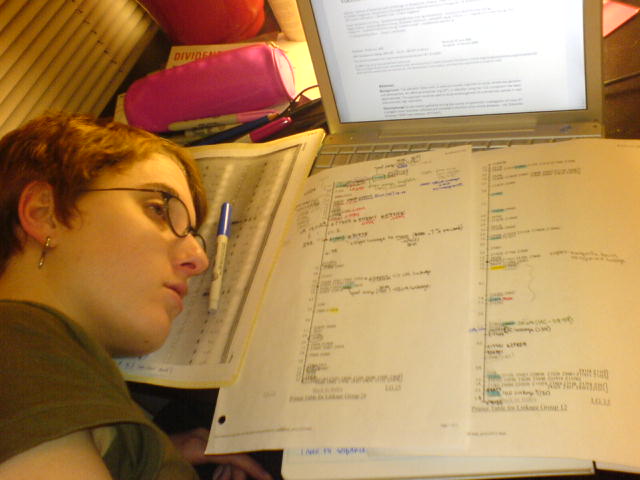
i think i've finally cracked the story behind my hugenormous mapping project that i've been working on for the past year+. and what i'm cracking open appears to be a story that's never been told before... so i'm exhilirated, bewildered, and a bit dizzy.
DSC00370.JPG
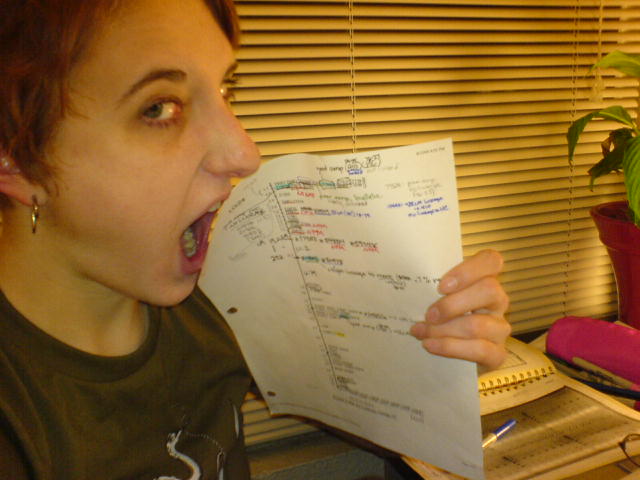
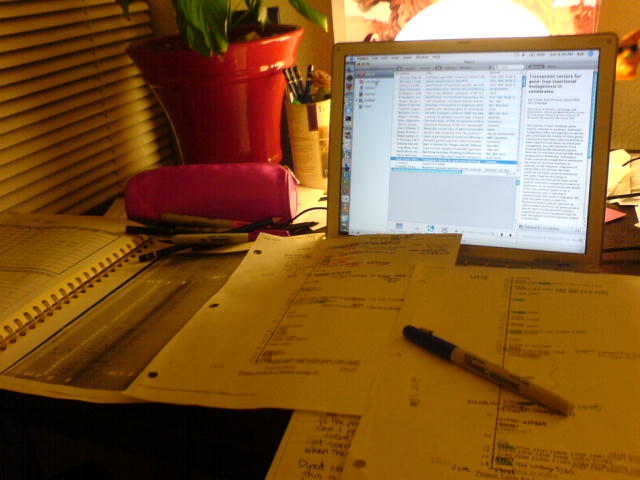
but i have about 10 pages of notes, plus 6 text files of possible parts of papers (rough first verbal diarrhea, but words output to digital format nonetheless) and that's not even counting the hundreds of gels i was flipping through, or the two detailed chromosome maps i've been annotating in color-coded sharpie.
DSC00374.JPG
look! random desk shot! next thing i'll be posting pictures of my cat on the internet. (oh wait.)

unfortunately, i didn't do shit for either of my classes the whole weekend. i worked on my research project from 10 AM to 1 AM (with maybe 2 hours of breaks cumulative) yesterday, and today it's been less intense, but i've put in at least 11 hours of sometimes half-assed note-consolidation and cross-referencing. but i've convinced myself of what my data is telling me, and i'm almost ready to communicate my ideas to my postdoc mentor and my PI. not quite though...

i'm not ready to publish anything public on this, but i believe that i have my hands on something extraordinary. not earth-shaking or nobel-winning by any means... but significant. which makes me feel really, really good.

good, and tired.